Freshly milled flour can bring better flavor and more control to home baking, but the right electric grain mill depends on what you grind, how often you use it, and how much flour you need per batch.
This roundup compares 10 options, from compact home mills designed for wheat and other grains to high-powered pulverizers suited to larger quantities and a wider range of dry ingredients.
Best 10 Electric Grain Mills Picks for 2026
Best Stone Mill

- 450-watt motor with thermal protection
- Corundum milling stones
- Adjustable texture-control knob
Best For: Home bakers wanting adjustable stone milling
Best High-Speed Grinder

- 2,800-watt motor at 28,000 rpm
- 750g capacity with stainless steel body
- Timed grinding from 70 to 300 mesh
Best For: Dry grains, spices, herbs, and coffee
Best Large-Batch Mill

- 50 kg capacity and about 110 lb/hour output
- 1,500-watt motor with cast-iron plates
- 30- to 300-mesh adjustment
Best For: Large-volume dry-grain and spice grinding
Best Extra-Capacity Mill
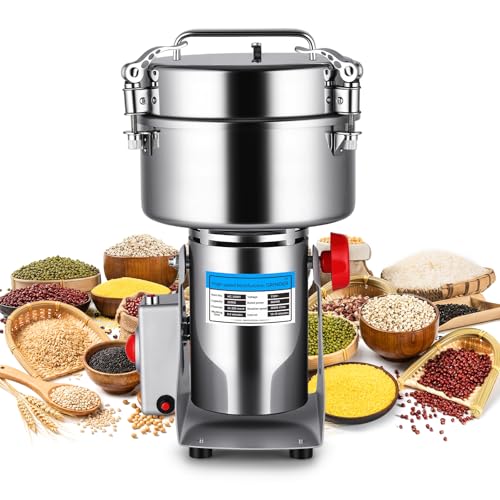
- 3,000g capacity for larger batches
- 270-degree swing with triple-layer blades
- Overload protection and 30- to 300-mesh range
Best For: Home or small commercial dry-ingredient batches
High-Speed Dry Grinder
VEVOR 2100W Electric Grain Mill

- 28,000-RPM motor for rapid dry grinding
- 30–300 mesh fineness and timed controls
- 800-gram cup with swing-style design
Best For: Dry grains, spices, coffee, and cereal
Fresh Flour Specialist
NutriMill Impact Compact Grain Mill

- 1200-watt motor for hard grains
- Impact heads target fine bread flour
- 8-cup hopper and 12-cup canister
Best For: Frequent bread bakers making fresh wheat flour
Wet-and-Dry Workhorse
VEVOR 3000W Commercial Grain Mill

- Supports both wet and dry grinding
- 3000W motor with adjustable thickness
- Cast-iron body and stainless-steel funnel
Best For: Heavy-duty grain, flour, feed, and wet processing
Best Compact Grain Mill
Kitchen Mill Electric Grain Mill

- Makes up to 24 cups in under 10 minutes
- Compact 7.6-pound design
- Stainless steel chamber is easy to clean
Best For: Home bakers milling grains and legumes
Best High-Power Grain Pulverizer
VEVOR 750g Electric Grain Mill

- 2000W motor reaches 28,000 rpm
- 750g stainless steel grinding capacity
- Lid lock and overload protection
Best For: Fast grinding of dry grains, spices, and coffee
Best Multi-Ingredient Grinder
750g High-Speed Electric Grain Mill
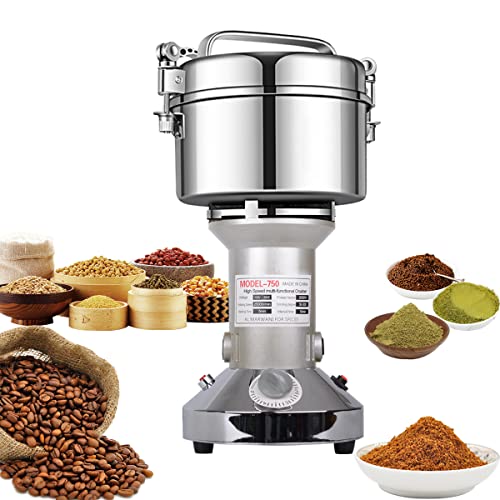
- 2000W motor with 25,000 rpm speed
- Grinds grains, spices, herbs, and coffee
- 750g capacity with overload protection
Best For: Batch grinding a variety of dry ingredients
Best Stone Mill – NutriMill Harvest
The NutriMill Harvest is a comparatively compact choice among electric grain mills, combining a 450-watt motor with corundum grainmaster milling stones. Its texture-control knob makes it suited to home users who want to adjust the grind for different kitchen tasks.
Best For: Home bakers seeking an adjustable stone grain mill with thermal protection.
Pros:
- 450-watt heavy-duty motor.
- Near-diamond-hard corundum milling stones.
- Patented texture-control knob for adjustable results.
- Auto-shutoff thermal protection and CSA testing.
Cons:
- Its 18.7-pound weight may limit portability.
- Stone milling may be less appropriate for shoppers specifically seeking a high-speed blade grinder.
With its manageable 7-by-7-inch footprint, 13-inch height, and USA assembly, the Harvest emphasizes controlled home milling rather than high-volume commercial processing.
Best High-Speed Grinder – 750g Stainless Steel Mill
This 750g stainless steel model is one of the more powerful electric grain mills for shoppers who also grind spices, herbs, and coffee. Its 2,800-watt motor reaches 28,000 rpm, while timed operation lets you control grinding duration and fineness.
Best For: Users needing a versatile, high-speed grinder for dry grains and other ingredients.
Pros:
- Food-grade 304 stainless steel construction.
- 2,800-watt, 28,000-rpm motor.
- Handles grains, spices, herbs, and coffee beans.
- Adjustable timer and stated 70- to 300-mesh fineness range.
Cons:
- Continuous grinding should not exceed five minutes, followed by a 5- to 10-minute cooling period.
- The grinding chamber should be filled no more than two-thirds full.
- It must be wiped clean rather than rinsed directly with water.
The 750g capacity and 8.3-by-8.3-inch footprint balance batch size and counter space, but its operating limits make timed, intermittent use important.
Best Large-Batch Mill – VEVOR Commercial Pulverizer
The VEVOR commercial electric grain mill is built for larger batches, with a 50 kg capacity and a stated processing rate of about 110 pounds per hour. Its 1,500-watt motor, cast-iron grinding plates, and adjustable 30- to 300-mesh range suit dry-grain and spice work where throughput matters.
Best For: Farms, ranches, labs, and other users handling substantial quantities of dry materials.
Pros:
- Stated capacity of 50 kg and output of about 110 pounds per hour.
- 1,500-watt motor with 1,400-rpm operation.
- Adjustable grinding fineness from 30 to 300 mesh.
- Cast-iron construction, cooling vents, and non-slip feet.
Cons:
- At 47.2 pounds and 28.15 inches tall, it is bulky for small kitchens.
- It is intended for dry materials and is not suitable for wet, oily, or sticky ingredients.
- Its industrial design may be more machine than occasional home users need.
This model prioritizes stability and throughput over portability, making its large footprint and heavy construction worthwhile mainly for frequent, large-volume grinding.
Best Extra-Capacity Mill – Jivoxia 3000g Grinder
The Jivoxia 3000g model gives home and small commercial users a large 6.6-pound batch capacity in a stainless steel body. Its 270-degree swing design, triple-layer blades, and stated 30- to 300-mesh range are aimed at producing fine powder from dry grains, spices, and coffee beans.
Best For: Users who want extra batch capacity for dry ingredients without moving to a full industrial-style mill.
Pros:
- Large 3,000g capacity for bigger batches.
- 270-degree swing motion and triple-layer stainless steel blades.
- Handles dry grains, spices, herbs, and coffee beans.
- Overload protection with a manual reset button.
Cons:
- Grinding sessions should be limited to three minutes, followed by 5 to 10 minutes of cooling.
- The chamber should not be filled beyond two-thirds capacity.
- It must be cleaned with a brush or damp cloth rather than rinsed with water.
The generous capacity is useful for batch processing, but the required cooling intervals mean it is better for staged production than uninterrupted grinding.
High-Speed Dry Grinder – VEVOR 2100W Electric Grain Mill
For shoppers comparing electric grain mills, this VEVOR model is a high-speed option for dry grains, cereals, coffee, and spices. Its 2100-watt motor, timed controls, and adjustable grinding range make it suited to quick small-batch powdering, but it is not designed for wet, oily, or sticky ingredients.
Best For: Dry grains, spices, coffee, and cereal users who want fast, fine grinding with timed operation.
Pros:
- 28,000-RPM motor and triple stainless-steel blades grind dry ingredients quickly.
- Adjustable fineness from 30 to 300 mesh with 5-, 15-, and 30-second timer settings.
- 800-gram grinding cup and 270-degree swing design help improve batch efficiency.
- Simple four-step operation and wipe-down cleaning.
Cons:
- Limited to dry materials; wet, oily, and sticky ingredients are not suitable.
- Requires a 5- to 10-minute rest after up to 5 minutes of continuous operation.
This is a practical pick when speed and powder fineness matter more than wet-grinding capability. The included sieve and compact stainless-steel housing add utility for dry kitchen or laboratory grinding tasks.
Fresh Flour Specialist – NutriMill Impact Compact Grain Mill
Among electric grain mills, the NutriMill Impact Compact is focused on producing fine flour from hard grains such as wheat. Its 1200-watt motor, impact milling heads, and large hopper and canister capacities make it a useful fit for regular bread baking without requiring a permanently bulky countertop setup.
Best For: Frequent bread bakers milling wheat and other hard grains into fine flour.
Pros:
- 1200-watt motor is designed to handle hard grains such as wheat.
- Impact milling heads are intended for consistent, fine-textured bread flour.
- 8-cup hopper and 12-cup flour canister support larger batches.
- Nesting parts and patented cyclone air filtration support convenient storage and airflow.
Cons:
- Its supplied features emphasize dry flour milling rather than wet or broad-purpose grinding.
- The design is specialized for flour production, so it may be less versatile for users seeking a spice or wet grinder.
The NutriMill stands out as a flour-first choice rather than an all-purpose pulverizer. Choose it if consistent bread flour, batch capacity, and compact storage are more important than grinding a wide range of materials.
Wet-and-Dry Workhorse – VEVOR 3000W Commercial Grain Mill
This VEVOR is one of the more versatile electric grain mills in this roundup, combining dry milling with wet grinding. Its 3000-watt motor, adjustable thickness control, funnel feed, and cast-iron construction are geared toward heavier-duty processing of grains, feed, soaked soybeans, rice, and food ingredients.
Best For: High-capacity users who need both dry flour milling and wet processing for items such as soaked soybeans and rice.
Pros:
- Two-in-one design includes separate cast-iron discs for dry and wet grinding.
- 3000-watt motor supports continuous, high-capacity grinding.
- Adjustable thickness control handles grains, spices, coffee, cereals, wheat, and nuts.
- Stainless-steel funnel and solid cast-iron body are built for prolonged use.
Cons:
- Large industrial dimensions make it less suitable for compact kitchens or easy storage.
- Its heavy-duty construction and broad capabilities may be more than occasional users need.
Choose this model when versatility and throughput are priorities. It is particularly compelling for users who want one machine for dry flour and wet soybean or rice processing, provided they have room for its industrial-sized frame.
Best Compact Grain Mill – Kitchen Mill Electric Grain Mill
For shoppers comparing electric grain mills, the Kitchen Mill stands out as a compact option designed for quickly producing whole-grain flour. Its 1000W motor can make up to 24 cups in under 10 minutes, while the stainless steel milling chamber is designed to resist gumming, jamming, and glazing.
Best For: Home bakers who want a compact, easy-to-clean mill for wheat, corn, rice, popcorn, beans, and other dry grains.
Pros:
- Produces up to 24 cups of flour in under 10 minutes.
- Stainless steel chamber supports consistent milling without gumming or glazing.
- Compact, lightweight design weighs about 7.6 pounds.
- Includes an 8-year limited warranty on the plastics and motor, plus a lifetime grinding-mechanism warranty.
Cons:
- The included specifications list plastic and stainless steel construction, so it may feel less all-metal than commercial-style mills.
- Its listed capacity is 3.8 pounds, which may require multiple batches for larger jobs.
This is a practical pick when convenience, compact storage, and fast flour production matter more than a commercial-size hopper. The clear mill pan also makes it easy to monitor output while working.
Best High-Power Grain Pulverizer – VEVOR 750g Electric Grain Mill
The VEVOR 750g electric grain mill is built for shoppers who prioritize high-speed, fine grinding. Its 2000W motor reaches 28,000 rpm and is designed to pulverize dry grains, cereals, coffee, and spices into a superfine powder, with a stated fineness range of 30 to 300 mesh.
Best For: Users who need a high-power dry grinder for grains, spices, coffee beans, and other non-wet ingredients.
Pros:
- 2000W motor and three-layer blade design support fast grinding.
- 750g capacity accommodates larger batches than many small countertop grinders.
- Stainless steel construction is food-grade and durable.
- Lid-lock and overload-protection features add operating safeguards.
Cons:
- Operation is limited to 5 minutes at a time, followed by a 5–10-minute rest.
- It is intended only for dry materials and should not be used with wet, fresh, oily, or sticky ingredients.
- The grinding tank should be cleaned with a brush or dry cloth rather than rinsed directly with water.
Choose this model for speed and fine powder production rather than traditional flour-mill convenience. Its timer, safety cutoff, and generous 750g capacity make it useful for repeated dry-grinding tasks, provided you follow the rest intervals.
Best Multi-Ingredient Grinder – 750g High-Speed Electric Grain Mill
This 750g electric grain mill is a versatile high-speed grinder for dry grains, spices, herbs, coffee, and similar ingredients. Its 2000W motor and triple-blade system are designed to reach a fineness of 50 to 300 mesh, while the stainless steel body provides a sturdy countertop setup.
Best For: Households and small food-preparation spaces that want one machine for dry grains, spices, herbs, coffee, and dried-food ingredients.
Pros:
- 2000W motor spins at up to 25,000 rpm for quick grinding.
- 750g capacity and triple-blade design support a broad range of dry ingredients.
- Automatic overload shutoff helps protect the machine during use.
- Stainless steel construction is sturdy and easy to wipe clean.
Cons:
- Recommended operation is no more than 3 minutes, followed by a 5–10-minute rest.
- It cannot grind wet, moist, or oily ingredients.
- The motor and grinding compartment should not be rinsed directly with water.
This model makes sense if versatility is the priority and your ingredients are consistently dry. It offers substantial power and capacity, but the short operating cycle means it is better suited to batch grinding than continuous milling.
How We Picked These Electric Grain Mills
We focused on the specifications that matter most in everyday use: motor power, stated capacity, milling speed, construction, adjustment options, intended ingredients, and ease of handling. The selection includes dedicated home flour mills as well as high-speed stainless-steel and cast-iron pulverizers marketed for grains, spices, corn, and other dry ingredients.
Because advertised wattage and output can vary by ingredient, moisture level, grind setting, and operating time, treat performance claims as comparisons rather than guarantees. A mill designed for occasional flour making may be a better fit than a commercial-style machine if convenience and countertop storage are priorities.
Quick Comparison
| Type | Best For | What to Look For |
|---|---|---|
| Compact home mill | Fresh flour and regular baking | Manageable size, milling consistency, simple cleanup |
| High-speed 750g mill | Small batches and dry ingredients | Stainless-steel chamber, safety features, usable batch size |
| Large-capacity pulverizer | Bulk processing and frequent use | Heavy-duty housing, stable base, ventilation, duty cycle |
| Adjustable commercial-style mill | Different textures and ingredients | Thickness control, hopper design, replacement parts |
Key Buying Factors for Electric Grain Mills
Grind Type and Texture Control
Choose a purpose-built grain mill if your main goal is flour for bread, pastries, or whole-grain baking. Look for adjustable settings when you want to move between coarse meal and finer flour. Pulverizers can be versatile, but their high-speed blades may produce heat and a less uniform texture than a stone or burr-style milling system.
Power, Capacity, and Duty Cycle
Higher wattage can help with hard grains and larger batches, but it does not automatically mean better flour. Consider the amount you normally process, whether the machine can run continuously, and how much counter space it requires. Small hoppers suit fresh, made-to-order baking; larger capacities reduce refilling during bulk work.
Materials, Safety, and Cleanup
Stainless steel is useful for durability and easier cleaning, while cast-iron construction can add stability but also weight. Confirm that the mill is intended for dry ingredients, has a secure lid or locking mechanism, and includes overload or overheating protection where possible. Never process wet ingredients unless the manufacturer specifically permits it.
Noise and Storage
Fast electric mills are generally loud, especially at high speed. Check dimensions and weight before buying, and consider whether you will leave the unit assembled or store it after each use. A stable, non-slip base is particularly important for powerful machines.
Who Should Buy Which Electric Grain Mills?
Choose a compact home grain mill if you mainly make fresh wheat flour and want a simpler appliance for regular baking. Choose a 750g stainless-steel grinder for modest batches of dry grains, spices, or herbs and easier storage. Choose a larger commercial-style pulverizer if you process substantial quantities, need more motor power, or value versatility over compactness. For frequent bread baking, prioritize consistent flour texture and practical adjustment controls over the highest advertised RPM.