Grinding your own grain in large quantities can improve freshness, control, and cost—but only if your mill matches your workload. The best choice depends on batch size, grain type, speed, cleanup, and available power.
This roundup compares 10 high-capacity grain mills, including electric stone mills, commercial-style pulverizers, agricultural grinders, and manual models for off-grid or hands-on use.
Best 10 Grain Mills for Large Batches Picks for 2026
Balanced Home Milling
NutriMill Harvest Electric Stone Grain Mill

- 450-watt motor with thermal protection
- Corundum stones and adjustable texture control
- Automatic shutoff; assembled in the USA
Best For: Home bakers seeking adjustable stone-ground flour
High-Output Fine Grinding
750g Stainless Steel Grain Mill

- 2800-watt motor rated at 28,000 rpm
- 750-gram capacity with timer control
- Handles grains, spices, herbs, and coffee
Best For: Fast, fine dry-ingredient grinding with cooling breaks
Heavy-Duty Manual Milling
Lehman's Diamant European Grain Mill
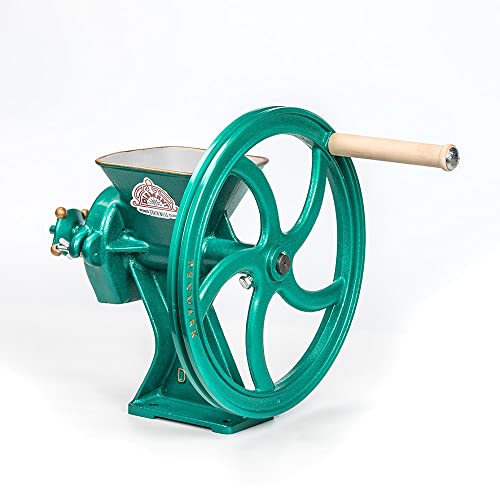
- 56-pound cast-iron construction
- Large burrs with fine-to-coarse adjustment
- Can mill grains, legumes, spices, seeds, and nuts
Best For: Long-term homestead or workshop milling
Large-Batch Bread Flour
NutriMill Impact Compact Grain Mill

- 1200-watt motor for hard grains
- 8-cup hopper and 12-cup flour canister
- Compact nesting design with cyclone filtration
Best For: Frequent bread bakers milling larger quantities
Classic Hand-Crank Pick
Victoria High-Hopper Cast Iron Mill

- 2,400-gram capacity for larger manual loads
- Durable cast-iron body and adjustable grind
- Versatile for grains, corn, seeds, and spices
Best For: Hands-on batch grinding without superfine flour requirements
High-Output Electric Pick

- 3,000W motor for continuous grinding
- Wet-and-dry discs expand its uses
- Adjustable thickness and steady funnel feeding
Best For: High-volume grain, spice, crop, and wet-food processing
Flour-Focused Manual Pick
Lehman's 6-Cup Power Grain Mill

- Six-cup hopper for fewer refills
- Stainless burrs grind dry grain to pastry flour
- 12-inch flywheel and motorization option
Best For: Home bakers processing larger batches of dry grain into flour
Versatile Farm Milling

- 25-liter capacity for home or farm batches
- Six sieves from 0.6 to 8 mm
- Removable hopper and replacement blade
Best For: Dry-grain milling with adjustable coarseness
Fast Fine Powder Milling

- 28,000 RPM motor for rapid grinding
- Timed 5-, 15-, and 30-second settings
- 1.8-pound cup with 30–300 mesh range
Best For: Fast repeated batches of dry grains and spices
Maximum Batch Capacity

- 60-liter capacity for substantial farm batches
- 1500W motor reaches 19,000 RPM
- Six sieve options and enclosed grinding chamber
Best For: High-volume dry grain and animal-feed milling
Balanced Home Milling – NutriMill Harvest Electric Stone Grain Mill
For home bakers comparing grain mills for large batches, the NutriMill Harvest combines a 450-watt motor with durable corundum milling stones and a texture control knob. Its thermal protection and automatic shutoff add practical safeguards during regular kitchen use.
Best For: Home users who want adjustable stone-ground flour and a sturdy, USA-assembled electric mill.
Pros:
- 450-watt heavy-duty motor
- Near-diamond-hard corundum milling stones
- Patented texture control knob
- Automatic shutoff with thermal protection
Cons:
- At 18.7 pounds, it is not especially lightweight
- Its 450-watt motor is less powerful than some commercial-style options
The Harvest is a sensible choice when adjustable texture and stone milling matter more than maximum motor output. It offers a durable, purpose-built design for frequent kitchen milling.
High-Output Fine Grinding – 750g Stainless Steel Grain Mill
For grain mills for large batches that prioritize speed and fine output, this stainless steel model uses a 2800-watt motor spinning at 28,000 rpm. Its 750-gram capacity and adjustable timer make it suitable for grains, spices, herbs, and other dry ingredients.
Best For: Users needing fast, superfine grinding for dry ingredients in home, restaurant, or food-processing settings.
Pros:
- High-power 2800-watt copper motor
- 750-gram grinding capacity
- Adjustable crushing fineness from 70 to 300 mesh
- Food-grade 304 stainless steel construction
Cons:
- Continuous grinding should not exceed five minutes
- Requires a five- to ten-minute cooling period after continuous use
- Machine should be wiped rather than rinsed directly with water
This mill offers impressive speed and fine-grinding control, but its required cooling intervals are important when planning repeated large batches. Follow the fill and maintenance instructions to protect the motor.
Heavy-Duty Manual Milling – Lehman's Diamant European Grain Mill
Among grain mills for large batches, the Lehman’s Diamant stands out for its substantial cast-iron construction and oversized burrs. It is a hand-crank mill that can process grains, legumes, spices, nuts other than peanuts, and seeds, while also offering a design that can be motorized.
Best For: Homesteaders, bakers, and users who want a long-lasting manual mill for flour, meal, and animal feed.
Pros:
- Large 5-1/4-inch machined iron burrs
- Adjusts from powder-fine to coarse
- Processes grains, beans, spices, seeds, and more without changing burrs
- Solid cast-iron flywheel can be motorized
Cons:
- Heavy 56-pound construction
- Manual hand-crank operation requires physical effort
- Hand-wash-only care
The Diamant is built for durability and versatility rather than compact convenience. Its large burrs and motorization potential make it a strong long-term option for substantial milling needs.
Large-Batch Bread Flour – NutriMill Impact Compact Grain Mill
For grain mills for large batches in a home baking setup, the NutriMill Impact uses a 1200-watt motor and stainless steel impact milling heads designed for fine bread flour. Its 8-cup hopper and 12-cup flour canister support repeated baking sessions while the compact parts nest for storage.
Best For: Frequent bread bakers who need fine flour, generous batch capacity, and space-conscious storage.
Pros:
- 1200-watt motor handles hard grains such as wheat
- Stainless steel impact milling heads target fine bread flour
- 8-cup hopper and 12-cup flour canister
- Patented cyclone air filtration supports airflow
Cons:
- Designed specifically around fine-textured bread flour rather than a broad range of stated uses
- Its larger batch components may still require storage space despite nesting
The Impact Compact is a strong fit for bread-focused households that value capacity without giving up a storage-friendly design. Its stated 20-cup capacity makes it especially practical for frequent baking.
Classic Hand-Crank Pick – Victoria High-Hopper Cast Iron Mill
For shoppers comparing grain mills for large batches, the Victoria offers a durable manual setup with a 2,400-gram capacity and a tall hopper. Its cast-iron body, adjustable screw, and table clamp make it a practical choice when you want hands-on control over grind texture.
Best For: Manual batch grinding of corn, grains, coffee, seeds, spices, and other foods where an ultra-fine flour texture is not required.
Pros:
- 2,400-gram capacity and high hopper support larger manual loads.
- Heavy-duty cast-iron construction with erosion-resistant discs.
- Adjustable screw lets you control coarseness and fineness.
- Clamp, rubber protector, and wooden crank handle support stable operation.
Cons:
- Manual grinding requires physical effort, especially for larger batches.
- It cannot produce a superfine texture or fine whole-wheat powder.
- Limited 90-day warranty.
The Victoria is a sturdy, versatile option for users who prioritize durability and simple manual operation. Choose it for coarse-to-medium grinding and varied kitchen or homestead tasks rather than pastry-fine flour production.
High-Output Electric Pick – VEVOR 3000W Wet & Dry Mill
Among grain mills for large batches, the VEVOR stands out for its 3,000W motor and continuous grinding capability. It includes separate discs for dry and wet ingredients, adjustable thickness control, and a funnel designed to feed material steadily.
Best For: High-volume grinding of wheat, rice, corn, soybeans, spices, and feed, including wet soybean or rice processing for pulp.
Pros:
- Powerful 3,000W motor supports continuous, high-capacity grinding.
- Handles both dry ingredients and soaked soybeans or rice.
- Adjustable thickness control accommodates grains, spices, coffee, and nuts.
- Solid iron body and stainless-steel funnel are built for prolonged use.
Cons:
- Its industrial design and 27.56-inch height require substantial space.
- Electric operation may be excessive for occasional small-batch use.
- Supplied notes do not specify a finished flour capacity or warranty.
The VEVOR is the strongest fit here when speed and throughput matter most. Its wet-and-dry flexibility broadens its uses, but measure your available workspace before choosing this tall commercial-style machine.
Flour-Focused Manual Pick – Lehman's 6-Cup Power Grain Mill
For grain mills for large batches that still use manual power, Lehman’s model combines a six-cup hopper with a 12-inch flywheel. Its stainless steel burrs are designed to grind free-flowing dry grains down to pastry flour, and the mill can also be motorized.
Best For: Home bakers and self-sufficiency users who want larger manual batches of wheat, corn, rye, rice, quinoa, or small beans, including fine flour.
Pros:
- Six-cup hopper reduces the need for frequent refilling.
- Stainless steel burrs can grind dry grain to pastry flour.
- Large 12-inch flywheel helps make hand grinding easier.
- Pre-drilled base holes allow bolting, and the mill can be motorized.
Cons:
- At 26 pounds and 14 inches high, it is heavy and sizable.
- Designed for free-flowing dry ingredients rather than wet grinding.
- Manual operation can still be demanding for sustained large batches.
Lehman’s is the most flour-oriented manual choice in this group, especially for users who value pastry-fine results. Its substantial flywheel and motorization option offer more flexibility than a basic hand-crank mill, though the footprint and weight are considerable.
Versatile Farm Milling – 25L Grain Mill Grinder
For shoppers comparing grain mills for large batches, this 25-liter electric grinder offers a practical middle ground for home or farm use. It handles dry wheat, corn, soybeans, and similar materials, with continuous feeding and six interchangeable sieves for adjusting the grind.
Best For: Home or small-farm users who need flexible dry-grain milling and a manageable storage footprint.
Pros:
- 25-liter capacity supports substantial batch work.
- Six sieves provide grind sizes from 0.6 to 8 mm.
- Removable hopper and bucket simplify cleaning and storage.
- Includes a replacement blade and wrench.
Cons:
- Designed for dry materials only.
- Cleaning components must be completely dry before reassembly.
- The tall 33.07-inch design may require dedicated storage space.
This model is a useful choice when versatility and capacity matter more than compact countertop placement. Its replaceable blade and multiple sieves add practical flexibility, while the dry-only requirement should be kept in mind.
Fast Fine Powder Milling – VEVOR 2100W Grinder
Among grain mills for large batches, this VEVOR model emphasizes speed and fine powder production rather than a large holding bucket. Its 2100-watt motor, timed controls, and 1.8-pound cup suit repeated dry-ingredient grinding for kitchens, workshops, or labs.
Best For: Users who process smaller repeated batches of dry grains, spices, coffee, or cereals and want quick, fine results.
Pros:
- 28,000 RPM motor can grind dry ingredients in about 30 seconds.
- Timed settings offer 5-, 15-, and 30-second control.
- Supports a reported fineness range of 30 to 300 mesh.
- Compact stainless-steel housing is easy to wipe clean.
Cons:
- Its 1.8-pound capacity requires multiple batches for larger workloads.
- Not suitable for wet, oily, or sticky materials.
- Continuous operation is limited to five minutes followed by a 5–10 minute rest.
This grinder is best viewed as a high-speed batch processor, not a bulk-capacity farm mill. The timer and fine-grinding range add control, but larger jobs will require planned pauses and repeated fills.
Maximum Batch Capacity – 60L Industrial Grain Mill
For buyers prioritizing capacity in grain mills for large batches, this 60-liter electric grinder is the most bulk-oriented option here. Its 1500-watt motor is designed for dry grains, feed, rice, spices, and flour, while the sealed grinding area helps limit dust leakage.
Best For: Large homes and farms processing substantial quantities of dry grain or animal feed in batches.
Pros:
- 60-liter, 15.8-gallon capacity is suited to high-volume work.
- 1500-watt motor reaches speeds up to 19,000 RPM.
- Six sieve positions support coarse through fine output.
- Detachable storage design and enclosed chamber help with handling dust.
Cons:
- At 37.4 inches tall and 26.5 pounds, it needs substantial storage space.
- Materials must be dry, and the manufacturer recommends grinding in batches.
- Overheating protection can require a cooling step before reopening.
This is the strongest fit when minimizing refills is the priority. Its large capacity and farm-oriented design are useful for feed and grain work, but the size, batch guidance, and required cooling procedures make it better suited to a dedicated milling area than casual countertop use.
How We Picked the Best Grain Mills for Large Batches
We focused on capacity, motor power, grinding flexibility, durability, and practical batch handling. The selection includes mills for fresh flour, cracked grain, corn, soybeans, spices, and general dry-grain processing. We also considered hopper size, output control, cleanup, portability, and whether each design is better suited to home baking, frequent bulk production, or farm use.
Specifications can vary by grain hardness, moisture, grind setting, and operating conditions. Treat advertised wattage and capacity as starting points, and check the manufacturer’s instructions before processing unfamiliar ingredients.
Quick Comparison
| Best For | Recommended Type | Why It Stands Out |
|---|---|---|
| Fresh flour for regular baking | Electric stone or impact mill | Convenient operation and consistent flour production |
| Very large dry-grain batches | Commercial-style electric grinder | Higher power and larger processing capacity |
| Farm or multipurpose grain processing | Agricultural mill with sieves | Flexible sizing for wheat, corn, soybeans, and feed |
| Off-grid or backup grinding | Manual cast-iron mill | No electricity required and generally repairable |
Key Buying Factors for Grain Mills for Large Batches
Capacity and Throughput
Hopper capacity affects how often you need to refill, while throughput determines how quickly a batch is finished. For frequent bulk grinding, prioritize a large hopper and a motor designed for sustained operation. Avoid assuming that a larger hopper always means faster output.
Grinding Mechanism and Adjustability
Stone mills are popular for fresh flour and adjustable texture. Impact and pulverizer mills can work quickly and produce very fine results, but they may create more heat and noise. Agricultural models with interchangeable sieves offer more control over flour, meal, and feed sizes.
Motor, Duty Cycle, and Power
Higher wattage can support demanding workloads, but it is not the only performance measure. Look for cooling provisions, overload protection, recommended run times, and a clearly stated duty cycle. Confirm that the mill’s voltage and plug match your workspace.
Cleanup, Dust, and Safety
Fine flour and grain dust can spread quickly. Useful features include sealed housings, dust-control designs, detachable hoppers, easy-access grinding chambers, and secure lids. Always use dry grain that meets the manufacturer’s requirements, and allow hot components to cool before cleaning.
Who Should Buy Which Grain Mills for Large Batches?
Choose an electric stone or compact impact mill if your priority is convenient fresh flour for household baking. Select a high-powered commercial-style grinder when you regularly process large quantities and have suitable ventilation and electrical capacity. Farm users should consider an agricultural grinder with multiple sieves for broader grain and feed applications. A manual cast-iron model is the better fit for emergency preparedness, off-grid use, or buyers who value mechanical simplicity over speed.