Choosing the best airbrush system for automotive paint means balancing spray control, nozzle size, compressor performance, and cleanup. The right kit can handle fine pinstriping, panel touch-ups, custom graphics, and broader color work without overspending on features you will not use.
We compared 10 systems across compressor design, feed style, included accessories, spray versatility, and ease of maintenance to help you match a setup to your project size and experience level.
Best 10 Airbrush System for Automotive Paint Picks for 2026
Tanked Detail Workhorse
Cool Runner II 3-Tip Compressor Kit
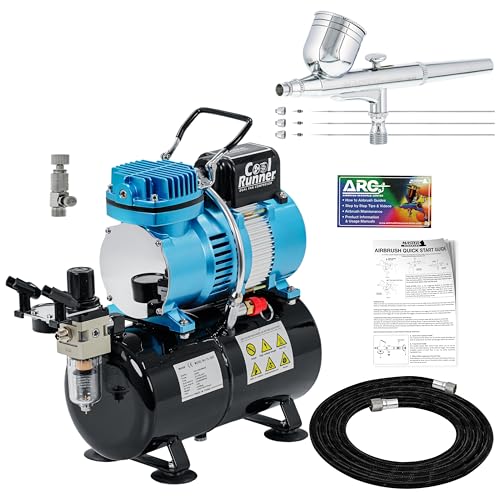
- 3-liter tank helps reduce pressure pulsation
- Includes 0.2, 0.3, and 0.5 mm tips
- Dual fans and moisture control for longer sessions
Best For: Automotive graphics and versatile workshop airbrushing
Beginner-Friendly Portable Pick

- Includes paint, cleaning tools, and beginner guidance
- Three tips cover fine detail to broader spraying
- Quiet, adjustable 34 PSI oil-free compressor
Best For: Beginners seeking a portable all-in-one kit
Precision Airbrush Upgrade

- Fine-detail to broad-coverage spraying
- Easy-clean compression-fit E3 nozzle
- Durable needle and solvent-resistant packings
Best For: Experienced users with an existing compressor
Multi-Brush Starter System

- Three airbrushes with gravity and siphon feeds
- Six acrylic colors plus reducer and cleaner
- Dual-fan 1/5 HP compressor for longer sessions
Best For: Users wanting varied brushes and included automotive practice supplies
Versatile Detail Pick
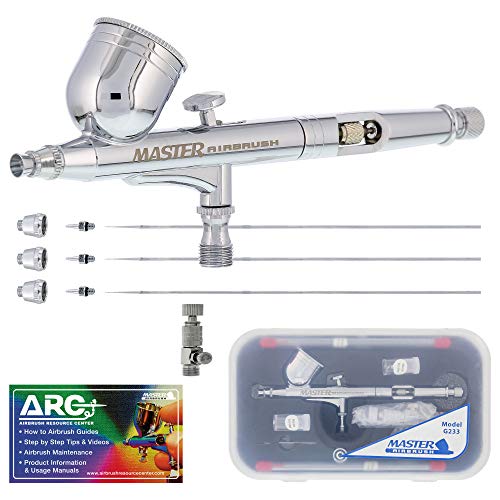
- Three nozzle sizes from 0.2 to 0.5 mm
- Dual-action gravity-feed control
- Includes hose and quick-disconnect valve
Best For: Automotive graphics, detailing, and varied spray sizes
Complete Starter Setup
Timbertech AS18-2K Airbrush Kit

- Includes compressor and 0.30 mm airbrush
- Portable 47 dB oil-less compressor
- Regulator, water trap, and safety features
Best For: Beginners needing a complete airbrush setup
Reliable Siphon-Feed Choice
Master Airbrush S68 Airbrush Gun

- 0.35 mm dual-action siphon-feed design
- Includes bottle and color cup
- Storage case and nozzle wrench included
Best For: Automotive touch-ups and general-purpose detailing
Versatile Workshop Pick
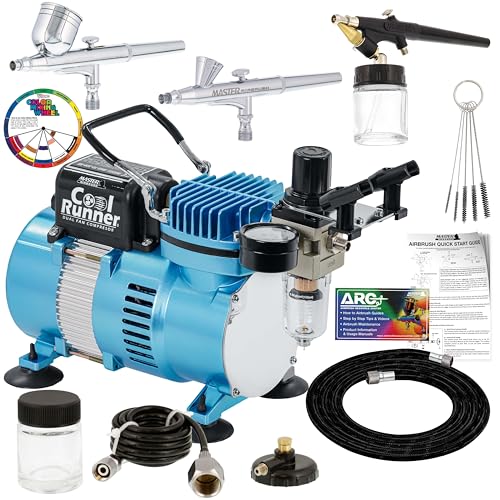
- Three airbrushes with gravity and siphon feed options
- Dual-fan compressor for longer running sessions
- Includes cleaning, mixing, holder, and guide accessories
Best For: Automotive graphics and varied airbrushing projects
Simple Detail Tool

- Dual-action trigger for adjustable paint and airflow
- 0.3mm nozzle with a 7cc gravity-feed cup
- Includes case, wrench, and refill dropper
Best For: Custom automotive detail work with an existing compressor
Compact Starter Option
50 PSI Dual-Action Airbrush Kit

- Includes compressor, airbrush, hose, and cleaning kit
- Three nozzles from 0.2mm to 0.5mm
- Dual-action control for detail and broader coverage
Best For: Beginners and compact DIY workstations
Tanked Detail Workhorse – Cool Runner II 3-Tip Compressor Kit
For an airbrush system for automotive paint, the Master Airbrush Cool Runner II combines a 3-liter air tank with a gravity-feed brush and three nozzle sizes. The tank is designed to maintain steady pressure with minimal pulsation, while the dual fans support longer operating sessions.
Best For: Automotive graphics, model work, and users who want a tank-based setup with fine-to-broad spray flexibility.
Pros:
- 3-liter air tank helps provide consistent, low-pulsation airflow.
- Includes 0.2 mm, 0.3 mm, and 0.5 mm tips for detail and wider coverage.
- Dual fans, pressure regulator, gauge, and water-trap filter support extended use.
- Includes a braided hose, holder, and beginner resource materials.
Cons:
- Stationary 12-pound design is less portable than compact tankless kits.
- The included G22 brush may be more setup than needed for occasional users.
Choose this model when stable airflow and longer sessions matter more than portability. Its included tip range also makes it a practical all-purpose option for automotive graphics and related projects.
Beginner-Friendly Portable Pick – InoKraft 4-Color Airbrush Kit
This InoKraft kit is a convenient starting point for an airbrush system for automotive paint, especially if you want paint, cleaning supplies, and guidance included. Its oil-free compressor provides adjustable airflow up to a listed 34 PSI, and the three-tip gravity airbrush covers detail through broader work.
Best For: Beginners, students, and hobbyists who want a portable, ready-to-use kit for automotive, model, and 3D projects.
Pros:
- Includes four paint colors, cleaning tools, practice sheets, and a beginner guide.
- Three nozzle sizes—0.2 mm, 0.3 mm, and 0.5 mm—support varied spray work.
- Oil-free compressor is listed at under 47 dB with adjustable pressure.
- Portable handle, carrying case, holder, and suction base add convenience.
Cons:
- Tankless design may offer less stored-air buffering than a traditional tank compressor.
- The included four colors may not match every automotive paint project.
Its complete accessory package reduces the setup decisions that can slow down new users. It is a sensible choice for learning and smaller automotive painting tasks where portability and included supplies are priorities.
Precision Airbrush Upgrade – Iwata Eclipse HP-CS Airbrush
The Iwata Eclipse HP-CS is the airbrush portion of an airbrush system for automotive paint rather than a complete compressor package. Its gravity-feed design and E3 nozzle are intended to provide smooth atomization from fine detail to broad coverage, while the cutaway handle simplifies needle access during cleaning.
Best For: Users who already have a compatible compressor and want a durable, versatile gravity-feed airbrush for automotive graphics and detailed work.
Pros:
- High-flow atomization supports fine lines through wider spray patterns.
- Compression-fit E3 nozzle has no threads and is designed for easy maintenance.
- Solvent-resistant needle packings support water-based, solvent, and pearlized paints.
- Break-resistant spring-steel needle adds durability.
Cons:
- Does not include a compressor, hose, or complete airbrush system accessories.
- Its 0.24-ounce cup is smaller than the paint capacity of some full kits.
This is a strong component choice for painters who prefer to build around their own compressor. Select it for control and maintenance convenience, but budget separately for the remaining system hardware.
Multi-Brush Starter System – Cool Runner II 3-Airbrush Kit
For shoppers comparing an airbrush system for automotive paint, this Cool Runner II package stands out for its three included airbrushes and six-color acrylic set. The dual-fan 1/5 HP compressor is paired with gravity-feed brushes for detail work and a siphon-feed brush with a larger bottle for broader application.
Best For: Makers who want one compressor and multiple feed styles for automotive graphics, models, crafts, and painting practice.
Pros:
- Includes three airbrushes: two gravity-feed models and one siphon-feed model.
- Tip sizes range from 0.2 mm and 0.3 mm to a broader 0.8 mm siphon-feed setup.
- Six opaque acrylic colors include reducer, cleaner, brushes, and a mixing wheel.
- Dual-fan compressor is designed for cooler, longer continuous operation.
Cons:
- More components may create a steeper learning curve for first-time users.
- The included acrylic paint set may not cover every automotive color or coating need.
- No air tank is listed in the supplied specifications.
This kit is appealing when versatility matters more than a minimal setup. The multiple brushes and paint supplies let users experiment with detail, coverage, and feed styles without buying each component separately.
Versatile Detail Pick – Master Airbrush G233 Pro Kit
If you want an airbrush system for automotive paint that can handle both fine detailing and broader coverage, the Master Airbrush G233 is a flexible option. Its gravity-feed, dual-action design includes 0.2, 0.3, and 0.5 mm nozzle setups, supporting extra-fine spray, general coverage, and backgrounds up to about 2 inches wide.
Best For: Automotive graphics, touch-up-style detailing, hobby projects, and users who want multiple nozzle sizes in one kit.
Pros:
- Three interchangeable nozzle, needle, fluid-tip, and air-cap sizes for varied spray work.
- Dual-action gravity-feed design with adjustable paint-flow control.
- Includes a 6-foot braided hose, quick-disconnect coupler, air-flow control valve, and cleaning-friendly cutaway handle.
- Backed by a 2-year manufacturer warranty.
Cons:
- The kit includes an airbrush and hose but not a compressor.
- Its broad application range may require practice when moving from fine detail to wider spray work.
The G233 stands out when versatility matters more than a compressor-included package. The 0.2 mm setup suits detail work, while the larger sizes give automotive and general-purpose users more flexibility.
Complete Starter Setup – Timbertech AS18-2K Airbrush Kit
For shoppers seeking an airbrush system for automotive paint with a compressor included, the Timbertech AS18-2K provides a compact starting setup. It combines a portable, oil-less compressor with a double-action gravity-feed airbrush, hose, cleaning supplies, test paints, and regulation features for straightforward airbrush projects.
Best For: Beginners working on automotive graphics, models, crafts, and other airbrush applications who need an all-in-one kit.
Pros:
- Includes a compressor, 0.30 mm gravity-feed airbrush, 6-foot hose, cleaning brush, mini filter, and five paints.
- Oil-less compressor is described as maintenance-free, portable, and quiet at 47 dB.
- Built-in regulator, pressure gauge, water trap, air filter, overheat protection, and safety valve add practical controls.
- Automatic start and stop operates between 3 and 4 bar.
Cons:
- The compressor is intended for airbrush use, not spray guns or other air tools.
- The included airbrush has one 0.30 mm nozzle size rather than multiple interchangeable setups.
This kit is a practical entry point because it supplies the main components needed to begin airbrushing without selecting a separate compressor. Its 23 L/min airflow and compact format suit airbrush work, but the stated limitations make it less appropriate for larger spray-gun jobs.
Reliable Siphon-Feed Choice – Master Airbrush S68 Airbrush Gun
The Master Airbrush S68 is a straightforward option for an airbrush system for automotive paint when you prefer a siphon-feed gun with a 0.35 mm tip. Its dual-action design is intended for controlled, detailed spraying and comes with both a 3/4-ounce bottle and a color cup for flexible paint handling.
Best For: Automotive touch-ups, hobby work, artwork, and users who prefer a simple siphon-feed airbrush.
Pros:
- 0.35 mm needle and nozzle support detailed, smooth spray work.
- Siphon-feed design includes both a 3/4-ounce fluid bottle and color cup.
- Dual-action operation is designed for users ranging from beginners to experienced airbrush artists.
- Includes an instruction guide, nozzle wrench, and molded plastic storage case.
Cons:
- This is an airbrush gun only and does not include a compressor or air hose.
- Its single 0.35 mm tip offers less nozzle-size range than multi-setup kits.
The S68 makes sense for buyers who already have compatible air-supply equipment and want a focused siphon-feed tool. The included bottle and cup add paint-container flexibility, while the 0.35 mm tip favors controlled general-purpose detailing.
Versatile Workshop Pick – Cool Runner II Airbrush Kit
For shoppers seeking an airbrush system for automotive paint, the Master Airbrush Cool Runner II offers a flexible setup with both gravity- and siphon-feed options. Its 1/5 hp compressor has dual cooling fans for longer continuous operation, while three included airbrushes cover detail work and broader applications.
Best For: Automotive graphics, multi-purpose airbrushing, and users who want several airbrush styles in one kit.
Pros:
- Includes three airbrushes: two dual-action gravity-feed models and one single-action siphon-feed model.
- Dual-fan compressor is designed to run cooler for longer continuous use.
- Includes a holder, cleaning brushes, color-mixing wheel, manual, and quick-start resources.
- Offers up to 57 psi and 0.8 cfm airflow according to the supplied specifications.
Cons:
- The larger multi-piece kit may be more equipment than occasional users need.
- Its listed 65 dB noise level may be noticeable in a quiet workspace.
This is the most complete choice of the three for users who want flexibility across automotive graphics and other airbrushing projects. The combination of multiple feed styles, cooling fans, and included accessories makes it a practical workshop-oriented package.
Simple Detail Tool – 0.3mm Gravity-Feed Airbrush
This compact gravity-feed airbrush is a straightforward option for an airbrush system for automotive paint when you already have a compatible air source. Its 0.3mm nozzle and dual-action trigger support controlled lines and coverage, while the stainless-steel body and included storage case suit regular hobby or custom-work use.
Best For: Detail-oriented automotive work, custom graphics, and buyers who need an individual airbrush rather than a complete compressor kit.
Pros:
- Dual-action control lets you adjust air and paint flow from the trigger.
- 0.3mm nozzle and 7cc gravity-feed cup support a range of spraying tasks.
- Compatible with automotive urethanes, lacquers, enamels, acrylics, inks, and dyes according to the supplied notes.
- Includes an eye dropper, nozzle wrench, and portable storage case.
Cons:
- No compressor is included, so a separate compatible air source is required.
- The small 7cc cup may require more frequent refills during larger jobs.
Choose this model if you value a focused, portable airbrush and already own or plan to add a compressor. It is less of a turnkey system, but its dual-action control and automotive-media compatibility make it useful for controlled custom work.
Compact Starter Option – 50 PSI Dual-Action Airbrush Kit
For beginners comparing an airbrush system for automotive paint and general creative work, this compact kit combines an airbrush compressor, dual-action gun, and three nozzle sizes. Its stated 50 PSI output and removable needle and nozzle are intended to support smooth spraying and easier maintenance when paint is properly thinned and the tool is cleaned after use.
Best For: Beginners and DIY users who want a compact, all-in-one kit for detail work, broader coverage, and varied projects.
Pros:
- Includes 0.2mm, 0.3mm, and 0.5mm nozzles for detail through broader spraying.
- Dual-action trigger supports air and paint-flow control for lines, shading, and gradients.
- Complete set includes compressor, hose, paint cups, replacement parts, and cleaning tools.
- Advertised up to 50 PSI output and a clog-resistant design for smoother workflow.
Cons:
- The supplied notes do not specify compatibility with particular automotive paint formulations.
- Proper paint thinning and cleaning are necessary to help prevent clogs and buildup.
- Its compact starter design may be better suited to smaller projects than sustained shop-scale spraying.
This kit is a convenient entry point for users who want the compressor and airbrush components together. The interchangeable nozzles add versatility, but automotive users should confirm that their chosen coating is suitable and prepare to follow careful thinning and cleaning practices.
How We Picked the Best Airbrush System for Automotive Paint
We evaluated each kit for the practical demands of automotive finishing: consistent airflow, controllable paint delivery, useful nozzle sizes, and the ability to produce both fine detail and wider coverage. We also considered whether the compressor includes a tank, how many airbrushes or accessories are supplied, and how easily the system can be cleaned between colors.
Dual-action gravity-feed models generally scored well for detail and efficient paint use, while siphon-feed options can be useful when you need larger color capacity or frequent color changes. Starter kits received credit for complete accessories, but included paints and tools were weighed less heavily than core spray performance.
Quick Comparison
| Best For | Look For | Why It Matters |
|---|---|---|
| Fine detailing | 0.2–0.3 mm nozzle | Supports controlled lines and small corrections |
| General automotive work | 0.3–0.5 mm options | Handles primers, color coats, and broader coverage more flexibly |
| Longer spraying sessions | Tank compressor | Reduces pulsation and limits constant compressor cycling |
| Frequent color changes | Multiple airbrushes or siphon feed | Speeds workflow and reduces repeated cleaning |
Key Buying Factors for an Airbrush System for Automotive Paint
Compressor and Airflow
A tank compressor is often preferable for automotive detailing because it can provide steadier airflow and reduce pressure fluctuations. Check the working PSI range, moisture management, noise level, and whether the compressor can keep up with your intended spray duration.
Nozzle and Feed Design
Smaller nozzles are suited to fine lines and touch-ups, but thicker coatings may require a larger setup and properly thinned paint. A gravity-feed brush uses less material and is convenient for small jobs; siphon feed is better when larger bottles or uninterrupted spraying matter.
Cleaning and Replacement Parts
Automotive coatings can dry quickly and clog precision components. Prioritize kits with accessible needles, nozzles, cleaning brushes, and replacement parts. Follow the coating manufacturer’s thinning and cleanup instructions rather than relying only on the included paints.
Ergonomics and Control
A comfortable dual-action trigger gives you separate control over airflow and paint volume, which is valuable for blending and fading. A stable stand, manageable hose, and balanced brush can make long sessions more precise.
Who Should Buy Which Airbrush System for Automotive Paint?
Choose a complete compressor kit if you are starting from scratch and want one purchase for hobby work, small repairs, and learning. Look for a tank-equipped dual-action setup if smooth, repeatable automotive detailing is your priority. A precision gravity-feed airbrush is the better choice for experienced users who already own a suitable compressor and need finer control. If you regularly switch colors or spray larger areas, consider a kit with multiple brushes, larger paint capacity, or both gravity- and siphon-feed options.
Before spraying a vehicle panel, test the mixture and pressure on scrap material. Use appropriate ventilation, respiratory protection, and coating-specific safety procedures, especially with automotive paints and solvents.