The best energy-efficient mini refrigerators balance low power use with dependable cooling, useful storage, and quiet operation. Whether you need a compact dorm fridge, office refrigerator, or bedroom beverage cooler, the right model can save space without creating unnecessary noise or energy costs.
We selected 10 compact refrigerators with features such as Energy Star certification, adjustable thermostats, reversible doors, freezer compartments, and low-noise compressors. Use the guide below to compare capacities and choose the best fit for your space and daily routine.
Best 10 Energy Efficient Mini Refrigerators Picks for 2026
Best Compact Energy Saver

- Energy Star certified and rated at 207 kWh annually
- Compact 1.6-cu.-ft. design with chiller box
- Reversible door and quiet operation under 42 dB
Best For: Bedrooms, dorms, and other tight spaces
Best Dorm-Size Storage
Upstreman 3.2 Cu. Ft. Mini Fridge

- 3.2 cu. ft. capacity with a 0.3-cu.-ft. freezer
- Energy Star certified and rated at 206 kWh annually
- Quiet 38 dB operation with adjustable shelving
Best For: Dorms, offices, and bedrooms needing extra storage
Best Retro Design
Frigidaire Coral 1.6 Cu. Ft. Mini Refrigerator

- Retro coral styling with a compact flush-back design
- Listed annual energy consumption of 200 kWh
- Includes chiller compartment, ice tray, and bottle basket
Best For: Stylish dorms, offices, RVs, and apartments
Best Freezer Capacity

- Includes a comparatively roomy 0.92-cu.-ft. freezer
- Energy Star certified with R600A compressor
- Removable shelves, crisper drawer, and interior LED light
Best For: Small kitchens and dorms needing meaningful freezer space
Best Value Compact Choice
3.2 Cu. Ft. Stainless Mini Fridge

- 3.2 cu. ft. capacity with compact freezer
- Reversible door and adjustable thermostat
- Shelves, door storage, and can dispenser
Best For: Dorms, offices, and apartments needing flexible storage
Best Quiet Small-Space Pick
2.6 Cu. Ft. Mini Fridge with Freezer

- Compact 2.6 cu. ft. dual-compartment design
- Low-noise cooling for bedrooms and offices
- Reversible door and adjustable shelving
Best For: Quiet personal cooling and freezing in tight spaces
Best Energy-Use Transparency

- Listed annual energy use of 180 kWh
- Quiet 38 dB compressor cooling
- LED light and reversible, adjustable layout
Best For: Energy-conscious dorm, bedroom, and office use
Best Organized Pick
Upstreman 3.1 Cu. Ft. Double-Door Mini Fridge
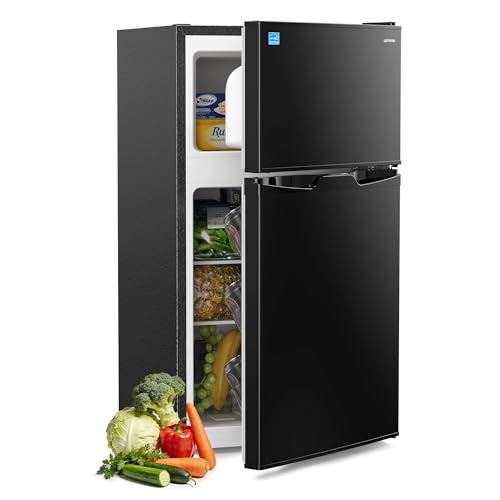
- Energy Star certified
- Separate freezer and crisper drawer
- Quiet operation as low as 40 dB
Best For: Organized dorm, bedroom, or apartment storage
Best Low-Cost Energy Pick
3.2 Cu. Ft. Single-Door Mini Fridge

- 0.55 kWh daily energy use listed
- Compressor noise below 37 dB
- One-touch defrosting system
Best For: Quiet bedrooms, offices, and budget-focused buyers
Best Spacious Capacity Pick
4.5 Cu. Ft. Two-Door Mini Fridge

- 3.65-cu.-ft. refrigerator compartment
- Separate 0.85-cu.-ft. freezer
- Reversible door and removable shelves
Best For: Dorms, offices, and shared spaces needing more storage
Best Compact Energy Saver – Midea 1.6 Cu. Ft. Mini Fridge
If you need one of the more compact energy efficient mini refrigerators for a bedroom, dorm, apartment, or garage, this Midea model keeps the footprint small while providing 1.6 cubic feet of storage. Its Energy Star certification, 207 kWh annual energy consumption, and quiet compressor make it practical for everyday use.
Best For: Small spaces where low noise, compact dimensions, and efficient beverage or snack storage matter most.
Pros:
- Energy Star certified with reported annual energy consumption of 207 kWh.
- Compact 1.6-cubic-foot design with a chiller box and 2L bottle rack.
- Reversible door and removable glass shelf support flexible placement and storage.
- Operates at less than 42 dB, according to the supplied specifications.
Cons:
- Its 1.6-cubic-foot capacity is limited for larger food-storage needs.
- Manual defrost requires periodic maintenance.
- The single shelf provides less organization than larger models.
This is a sensible choice when conserving space and electricity is more important than maximizing capacity. The adjustable thermostat and reversible door add useful everyday flexibility.
Best Dorm-Size Storage – Upstreman 3.2 Cu. Ft. Mini Fridge
Among energy efficient mini refrigerators, this Upstreman model stands out for combining a compact footprint with 3.2 cubic feet of total storage. It includes a separate 0.3-cubic-foot freezer, adjustable cooling, and a quiet 38 dB operating level for dorms, bedrooms, and offices.
Best For: Users who want more organized storage and a small freezer without moving up to a full-size refrigerator.
Pros:
- Energy Star certified with listed annual energy consumption of 206 kWh.
- Provides 2.9 cubic feet of refrigerator space plus a 0.3-cubic-foot freezer.
- Two adjustable glass shelves, a crisper drawer, and three door shelves improve organization.
- Quiet 38 dB operation, reversible door, and adjustable leveling feet suit shared spaces.
Cons:
- The freezer is not suitable for storing ice cream or ice cubes, according to the supplied notes.
- Manual defrost requires user maintenance.
- The taller 33.1-inch profile may not fit under every counter or desk.
With efficient operation and more usable organization than a tiny countertop unit, this is a well-rounded option for dorm or office living. Its freezer is best treated as a small supplemental compartment rather than a full freezer.
Best Retro Design – Frigidaire Coral 1.6 Cu. Ft. Mini Refrigerator
This Frigidaire retro mini refrigerator adds a decorative touch while keeping energy use relatively modest for its size. The 1.6-cubic-foot unit uses 200 kWh annually as listed, and its compact flush-back design works well in dorms, offices, RVs, garages, or apartments.
Best For: Buyers who want a compact refrigerator with retro styling, basic freezer space, and convenient drink storage.
Pros:
- Listed annual energy consumption is 200 kWh.
- Retro coral finish adds visual appeal to bedrooms, offices, and entertainment spaces.
- Includes a wire shelf, 2L door basket, chiller compartment, and ice cube tray.
- Reversible door and flush-back design offer flexible placement.
Cons:
- The 1.6-cubic-foot capacity is limited compared with taller 3.1- or 3.2-cubic-foot models.
- Its 0.2-cubic-foot freezer compartment provides only minimal frozen-food storage.
- Manual defrost requires occasional maintenance.
This model prioritizes style and convenience without giving up a compact, relatively efficient design. Choose it when appearance and a small footprint matter as much as basic cooling capacity.
Best Freezer Capacity – Midea 3.1 Cu. Ft. Mini Fridge
This Midea is a strong pick among energy efficient mini refrigerators when you need a dedicated freezer as well as refrigerator space. Its 3.1-cubic-foot layout includes a 0.92-cubic-foot freezer, removable glass shelves, an interior LED light, and an Energy Star-certified compressor system.
Best For: Dorms, apartments, garages, and small kitchens that need separate freezer storage in a compact refrigerator.
Pros:
- Energy Star certified and equipped with an R600A high-efficiency compressor.
- Offers a relatively large 0.92-cubic-foot freezer within a 3.1-cubic-foot unit.
- Removable glass shelves, a crisper drawer, and a 2L bottle rack support organized storage.
- Reversible door, interior LED lighting, and multi-airflow cooling add convenience.
Cons:
- At about 52.2 pounds, it is heavier than the smaller models in this roundup.
- Manual defrost requires periodic upkeep.
- The listed energy information is inconsistent: the notes cite 270 kWh/year in one section and 80 watts elsewhere.
This is the most suitable option here for shoppers who regularly need frozen-food capacity. Its two-section layout and flexible shelving make the extra size worthwhile for compact living spaces.
Best Value Compact Choice – 3.2 Cu. Ft. Stainless Mini Fridge
For shoppers comparing energy efficient mini refrigerators, the ARCTIC CHEF offers a practical compressor-cooled design with 3.2 cubic feet of storage, a compact freezer compartment, and an adjustable thermostat. Its reversible door and flat-back design make it easier to fit into dorms, offices, apartments, and other space-limited areas.
Best For: Buyers who want a roomy compact refrigerator with flexible placement and a dedicated ice compartment.
Pros:
- 3.2-cubic-foot capacity includes a 0.2-cubic-foot freezer compartment.
- Reversible door, adjustable leveling legs, and flat-back design support flexible installation.
- Adjustable thermostat and compressor cooling provide customizable temperature control.
- Two interior shelves, door shelves, and can storage improve organization.
Cons:
- At 42.7 pounds, it is heavier than some smaller personal refrigerators.
- Its 33.27-inch height may not suit every under-counter location.
The ARCTIC CHEF is a solid option when storage capacity and adaptable placement matter more than ultra-compact dimensions. Its stainless finish and practical interior layout also make it suitable for visible spaces.
Best Quiet Small-Space Pick – 2.6 Cu. Ft. Mini Fridge with Freezer
BANGSON Mini Refrigerator for Dorm Bedroom, Compact Fridge, Energy-efficient, Low Noise
Check Price On AmazonThe BANGSON is one of the more space-conscious energy efficient mini refrigerators in this group, combining a 2.6-cubic-foot capacity with a separate refrigerator and freezer area. Its low-noise cooling system, reversible door, and compact footprint make it well suited to bedrooms, study areas, offices, and dorm rooms.
Best For: People who need a quiet personal fridge with both refrigerated and frozen storage in a compact footprint.
Pros:
- Compact 18-by-19-by-27-inch design fits under counters and in tight rooms.
- Separate 2.1-cubic-foot refrigerator and 0.5-cubic-foot freezer compartments.
- Low-noise cooling system is designed for bedrooms, offices, and study areas.
- Reversible door, removable shelves, leveling legs, ice tray, and defrost tool add convenience.
Cons:
- Manual defrosting requires occasional maintenance.
- Its total capacity is smaller than the 3.2-cubic-foot models in this roundup.
- The supplied notes do not provide an annual energy-consumption figure.
The BANGSON prioritizes quiet operation and efficient use of limited space. Choose it when a dedicated freezer and bedroom-friendly design are more important than maximum interior capacity.
Best Energy-Use Transparency – 3.2 Cu. Ft. Quiet Mini Fridge
The EUHOMY stands out among energy efficient mini refrigerators with a listed annual energy consumption of 180 kWh and a quiet 38 dB compressor system. It provides 3.2 cubic feet of total storage, including a micro-freezer, while adding an LED light, adjustable shelves, and a reversible door for everyday convenience.
Best For: Shoppers who want a quiet 3.2-cubic-foot refrigerator with a stated energy-use figure and flexible organization.
Pros:
- Lists 180 kWh of annual energy consumption and low power use.
- Quiet 38 dB operation is appropriate for bedrooms, dorms, and offices.
- 3.2-cubic-foot capacity includes 2.9 cubic feet of refrigeration and a 0.3-cubic-foot micro-freezer.
- Reversible door, seven-position temperature control, LED light, and adjustable feet improve usability.
Cons:
- Manual defrosting requires periodic attention.
- The micro-freezer is intended for short-term frozen storage rather than a large freezer load.
- Its 31.1-inch height may be too tall for some counter spaces.
With its documented energy figure, quiet operation, and useful 3.2-cubic-foot layout, the EUHOMY is a strong fit for buyers balancing capacity, comfort, and energy awareness. The drip tray also simplifies condensation collection during defrosting.
Best Organized Pick – Upstreman 3.1 Cu. Ft. Double-Door Mini Fridge
For shoppers comparing energy efficient mini refrigerators, the Upstreman TM31 combines a separate freezer with organized fresh-food storage in a compact 3.1-cubic-foot design. Its Energy Star certification, 304 kWh annual energy use, and noise level as low as 40 dB make it practical for bedrooms, dorms, and apartments.
Best For: Buyers who want organized double-door storage, a dedicated freezer, and quiet certified efficiency.
Pros:
- Separate 2.22-cu.-ft. refrigerator and 0.88-cu.-ft. freezer compartments help prevent odor transfer.
- Energy Star certified with listed energy use of 304 kWh per year and operation as low as 40 dB.
- Includes adjustable glass shelves, a crisper drawer, beverage rack, interior light, and reversible door.
- Seven temperature settings support flexible cooling control.
Cons:
- Manual defrosting may require periodic maintenance.
- At 33.46 inches tall and 48.5 pounds, it needs more room and lifting effort than ultra-compact models.
The TM31 is a strong fit when food organization matters as much as energy efficiency. Its freezer and practical storage features make it more versatile than a basic beverage fridge, while the reversible door helps with placement in tight spaces.
Best Low-Cost Energy Pick – 3.2 Cu. Ft. Single-Door Mini Fridge
This 3.2-cubic-foot mini fridge stands out among energy efficient mini refrigerators for its listed consumption of 0.55 kWh per day and estimated operating cost of $0.07 per day. Its compact footprint, low-noise compressor, and freezer compartment suit bedrooms, offices, dorms, and other quiet spaces.
Best For: Budget-conscious shoppers prioritizing low listed energy use and quiet operation.
Pros:
- Lists energy use of 0.55 kWh per day and an estimated cost of $0.07 per day.
- Compressor noise is rated below 37 dB for sleep and work areas.
- Two detachable glass shelves, a crisper drawer, LED lighting, and six thermostat settings improve usability.
- One-touch defrosting and a detachable door seal simplify maintenance.
Cons:
- The freezer capacity is only 0.2 cubic feet.
- It has a single door, so freezer and refrigerator access are not separated.
- The listed door orientation is left, which may limit placement flexibility.
This model makes the most sense when keeping electricity use and noise low is more important than freezer space. Its maintenance-friendly defrosting system and flexible shelving add everyday convenience at a compact size.
Best Spacious Capacity Pick – 4.5 Cu. Ft. Two-Door Mini Fridge
For shoppers seeking energy efficient mini refrigerators with more usable storage, this 4.5-cubic-foot model provides a 3.65-cubic-foot refrigerator and a separate 0.85-cubic-foot freezer. Its low-energy-compression compressor, reversible door, and adjustable shelving make it a practical choice for shared rooms, offices, and dorms.
Best For: Users who need the most fresh-food and freezer capacity among these compact options.
Pros:
- Offers a spacious 3.65-cu.-ft. refrigerator plus a separate 0.85-cu.-ft. freezer.
- Listed energy use is as little as 1 kWh per day, with estimated daily cost of $0.14.
- Removable glass shelves, a crisper, full-width door bin, and interior LED light support organized storage.
- Reversible door and adjustable feet make placement easier on uneven floors.
Cons:
- Its 42.91-inch height and 56.2-pound weight require more installation space and effort.
- Manual defrosting requires periodic upkeep.
- It lists 356 kWh of annual energy consumption, higher than the smaller options here.
The BCD-127B is the capacity-focused choice. It uses more space and has higher listed annual consumption than the smaller models, but its larger refrigerator and freezer compartments can reduce the need for frequent restocking.
How We Picked the Best Energy Efficient Mini Refrigerators
We focused on compact refrigerators that offer a practical combination of energy-conscious operation, useful capacity, quiet performance, and flexible installation. Energy Star certification was given priority where available because it provides a standardized efficiency benchmark. We also considered adjustable thermostats, freezer design, door reversibility, shelf flexibility, noise claims, and the needs of dorm rooms, bedrooms, offices, and apartments.
Because manufacturer energy figures can vary by model and usage conditions, efficiency should be evaluated alongside capacity and cooling design. A larger refrigerator may use more electricity overall, but choosing the smallest suitable size can often reduce waste.
Quick Comparison
| Type | Best For | What to Look For |
|---|---|---|
| 1.6 cu. ft. single-door | Bedrooms and personal use | Low noise, reversible door, adjustable thermostat |
| 3.1–3.2 cu. ft. models | Dorms, offices, and shared spaces | Freezer compartment, removable shelves, efficient compressor |
| 4.5 cu. ft. two-door | Higher storage needs | Separate freezer, stable temperature control, adequate ventilation |
Key Buying Factors for Energy-Efficient Mini Refrigerators
Capacity and Layout
Choose capacity based on what you actually store. Around 1.6 cubic feet suits drinks, snacks, and a few personal items. Models near 3.2 cubic feet provide more room for groceries and commonly include a compact freezer. A 4.5-cubic-foot unit is useful when multiple people share the refrigerator, but it needs more floor space and may consume more energy.
Efficiency and Temperature Control
Look for Energy Star certification when available, and compare the manufacturer’s annual energy information. An adjustable thermostat helps maintain safe, consistent cooling without running the appliance harder than necessary. Avoid placing the refrigerator beside heaters or in direct sunlight, since warmer surroundings can increase energy use.
Noise, Ventilation, and Door Placement
Low-noise operation matters in bedrooms and study areas. Check the stated decibel rating when provided, but remember that compressor sounds can vary during cooling cycles. Measure the installation area, account for door swing, and leave the manufacturer-recommended clearance around ventilation areas. A reversible door is especially useful in tight rooms.
Freezer Design and Shelving
Compact freezer compartments are convenient for ice and frozen essentials, but they generally offer limited space. Removable or adjustable shelves make it easier to store taller containers and clean the interior. If frozen-food storage is important, prioritize a two-door model with a dedicated freezer rather than a small internal chiller box.
Who Should Buy Which Energy Efficient Mini Refrigerators?
- For a bedroom or personal workspace: Choose the smallest quiet model, such as a 1.6-cubic-foot refrigerator, when basic drink and snack storage is enough.
- For a dorm room: A 3.1- to 3.2-cubic-foot model with a freezer, reversible door, and adjustable thermostat offers a useful balance of storage and flexibility.
- For an office: Select a model with removable shelves and enough capacity for multiple users, while checking its noise rating and ventilation requirements.
- For shared apartments or larger storage needs: Consider the 4.5-cubic-foot two-door option, provided you have enough clearance and do not need full-size refrigerator capacity.