Choosing the right timegrapher can make mechanical watch diagnosis, regulation, and quality control faster and more consistent. The best models reveal timing performance clearly while remaining simple enough for routine bench work.
We compared 10 watch timing machines for watchmakers across display functionality, measurement capabilities, usability, and overall workshop practicality to help you select the right fit.
Best 10 Watch Timing Machines for Watchmakers Picks for 2026
Precision Bench Pick

- Claims ±0.1 s/d accuracy with 50-sample averaging
- Tests six positions with adjustable sampling cycles
- Displays rate, amplitude, beat error, lift angle, and graphs
Best For: Professional mechanical-watch diagnostics
Coaxial-Friendly Choice

- Works with almost all mechanical and coaxial watches
- Uses a larger LCD screen than the No.1000
- Supports 100V–240V power with exchange-plug options
Best For: Clearer bench testing of mechanical and coaxial watches
Flexible Sampling Pick
Multifunctional 6000 Timegrapher

- Tests mechanical and coaxial watches
- Offers sampling periods from 2 to 60 seconds
- Shows speed, amplitude, and beat error in real time
Best For: Versatile mechanical-watch testing and repair work
Collector-Friendly Value
- Calculates rate, amplitude, and beat error automatically
- Includes six positions and 2–60-second sampling
- Uses an LCD with visual tick-tock timing traces
Best For: Mechanical-watch collectors and routine timing checks
Reliable Bench Essential
NO.1000 Mechanical Watch Timegrapher

- Tests nearly all mechanical watches, including coaxial models
- Compact corded-electric design
- Suitable for professional watchmakers and collectors
Best For: Straightforward mechanical-watch timing checks
Precision Adjustment Choice

- Displays rate, amplitude, and beat error in real time
- Eight selectable sampling durations from 2–60 seconds
- Six positions with sound or mute operation
Best For: Detailed mechanical-watch analysis and adjustment
Large-Screen Workshop Pick

- Large high-resolution color LCD screen
- Shows five live mechanical-watch measurements
- Includes sensor, US adapter, and manual
Best For: Readable mechanical-watch testing at a watchmaking desk
Easy-Start Pick
No.1000 Mechanical Watch Timegrapher
- Live LCD readings for five key timing metrics
- Easy to use for hobbyists and professionals
- Works with most mechanical and coaxial watches
Best For: Collectors, hobbyists, and general mechanical-watch testing
Complete Workbench Kit
No.1000 Watchmaker Timegrapher

- Automatic and manual beat settings
- Live display of essential timing measurements
- Includes sensor, adapter, manual, and cleaning cloth
Best For: Amateur watchmakers, technicians, and calibration benches
Precision Analysis Pick
Multifunctional No.1000 Timegrapher
- Tests six key mechanical-watch measurements
- Offers adjustable sampling and directional testing
- Compact design with 100V–240V input support
Best For: Technicians and advanced users performing detailed diagnostics
Precision Bench Pick – SWANSOFT No.1000 Timegrapher
For watchmakers comparing watch timing machines for watchmakers, the SWANSOFT No.1000 offers detailed mechanical-watch diagnostics, including rate, amplitude, beat error, lift angle, and timing curves on a color LCD.
Best For: Professional watchmakers, technicians, and enthusiasts servicing mechanical movements, including antique or faulty watches.
Pros:
- Claims ±0.1 s/d accuracy with a 50-sample average and a ±999 s/d measurement range.
- Supports six testing positions and sampling cycles from 2 to 60 seconds.
- Displays rate, amplitude, beat error, lift angle, and live timing graphs.
- Includes adjustable lift angle from 30° to 70° and 12-month support.
Cons:
- Designed for mechanical watches only; it does not support quartz movements.
- Its extensive controls may be more than casual collectors need.
This is the most feature-focused option in the group for movement diagnosis. Choose it when precise readings and broad adjustment capability matter more than a simple, basic tester.
Coaxial-Friendly Choice – MTG No.1900 LCD Timegrapher
OTOOLWORLD New Coaxial MTG Watch Tester Timing Multifunction Timegrapher LCD Screen NO.1900
Check Price On AmazonThe MTG No.1900 is a practical choice among watch timing machines for watchmakers, with a larger LCD screen intended to improve visibility when testing mechanical and coaxial watches.
Best For: Watchmakers and collectors who want a larger-screen tester with coaxial-watch compatibility.
Pros:
- Designed for almost all mechanical watches and works better with coaxial watches.
- Larger LCD screen than the No.1000 for easier viewing and operation.
- Suitable for professional watchmakers as well as watch collectors.
- Supports 100V–240V power and includes exchange-plug options for several regions.
Cons:
- The supplied notes do not specify measurement ranges, sampling intervals, or displayed parameters.
- It is a corded-electric instrument, so bench placement near power is required.
The No.1900 stands out primarily for its larger display and coaxial-watch suitability. It is a sensible fit when straightforward operation and screen visibility are priorities.
Flexible Sampling Pick – Multifunctional 6000 Timegrapher
This multifunctional tester gives buyers of watch timing machines for watchmakers a broad set of sampling choices, automatic signal adjustment, and live readings for speed, amplitude, and beat error.
Best For: Amateur watchmakers, technicians, and users testing a wide range of mechanical watches, including coaxial models.
Pros:
- Compatible with almost all mechanical watches and coaxial watches.
- Offers sampling periods from 2 to 60 seconds for averaging test results.
- Provides six adjustable testing positions and automatic signal-level adjustment.
- Displays speed, amplitude, and beat error in real time on an HD LCD.
Cons:
- The supplied notes do not identify a brand or provide a warranty detail.
- At 4.4 pounds, it is relatively substantial for a portable bench tool.
With its long list of sampling intervals and automatic signal adjustment, this model offers useful flexibility without requiring manual signal setup for every watch. It is a strong middle-ground option for varied mechanical-watch work.
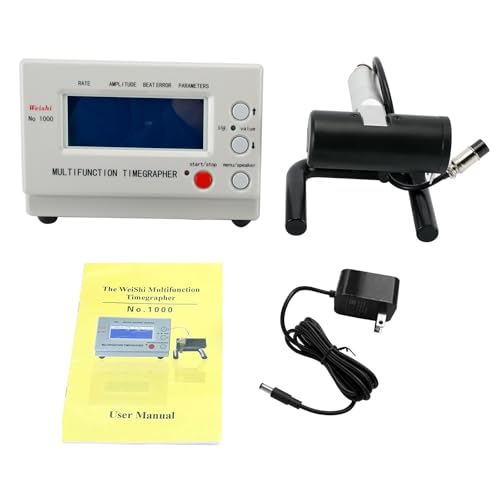
Collector-Friendly Value – YaeTek No.1000 Watch Tester
The YaeTek No.1000 is a straightforward option among watch timing machines for watchmakers, combining automatic signal adjustment, six test positions, and an LCD that shows timing readings and moving tick-tock traces.
Best For: Mechanical-watch collectors and users seeking a relatively simple LCD timing tester with broad sampling options.
Pros:
- Automatically calculates rate, amplitude, and beat error.
- Offers six adjustable testing positions and automatic optimal signal adjustment.
- Supports sampling periods from 2 to 60 seconds.
- Provides a ±999 s/d rate-deviation range with stated ±1 s/d precision.
Cons:
- The listed configuration uses a 110V–220V US plug, which may not suit every location directly.
- The supplied notes specify a 3-inch screen, smaller than some larger-display alternatives.
- The stated amplitude range is presented as 275–315, narrower than the ranges listed for some competing models.
This tester covers the core readings needed for routine mechanical-watch checking and adds useful sampling flexibility. It makes the most sense for collectors or developing watchmakers who want essential timing information without the more advanced feature set of premium instruments.
Reliable Bench Essential – NO.1000 Mechanical Watch Timegrapher
For watchmakers seeking watch timing machines for watchmakers, the NO.1000 is a compact, corded-electric timegrapher designed to test nearly all mechanical watches, including coaxial models. It measures beats per unit time and is suited to both professional benches and serious collections.
Best For: Watchmakers and collectors who need a straightforward mechanical-watch timing tester in a compact format.
Pros:
- Compatible with almost all mechanical watches, including coaxial watches.
- Multi-purpose design suited to professional watchmakers and collectors.
- Compact 6.77 x 1.57 x 4.49-inch form factor.
Cons:
- Designed for mechanical watches rather than quartz models.
- Requires corded electric power.
The NO.1000 focuses on core timing-machine functionality without an extensive list of supplied display or sampling features. It is a practical choice when broad mechanical-watch compatibility and a compact bench footprint matter most.
Precision Adjustment Choice – No.1900 Watch Timing Machine
This No.1900 is one of the more feature-focused watch timing machines for watchmakers, combining automatic signal calibration with selectable sampling periods and real-time LCD results. It is built for analyzing and adjusting mechanical watches, including coaxial timepieces.
Best For: Amateur watchmakers, technicians, manufacturers, and enthusiasts who want adjustable testing and detailed timing readouts.
Pros:
- Measures rate, amplitude, and beat error in real time.
- Offers sampling durations from 2 to 60 seconds.
- Includes six testing positions, sound or mute modes, and automatic signal-level calibration.
- Amplitude range is 100–360, with rate deviation shown to ±999 s/d at 1 s/d precision.
Cons:
- The supplied notes identify it as a generic model without a stated brand.
- Its feature set may be more than needed for basic timing checks.
With flexible sampling, visual ticking traces, and multiple adjustable parameters, this model is aimed at users who want more than a simple pass-through timing reading. Its compact package weight is listed at 2.2 pounds.
Large-Screen Workshop Pick – SWANSOFT No.1900 Timegrapher
The SWANSOFT No.1900 is a practical option among watch timing machines for watchmakers who prefer a larger, high-resolution color display. It is designed exclusively for mechanical movement watches and shows live rate, amplitude, beat error, beat, and lift angle readings.
Best For: Hobbyists, collectors, watchmakers, and technicians who want an easy-to-read screen for mechanical-watch calibration.
Pros:
- Upgraded larger, high-resolution color LCD screen.
- Displays rate, amplitude, beat error, beat, and lift angle.
- Includes a timegrapher sensor, US adapter, and professional user manual.
- One-year warranty and customer service are listed.
Cons:
- Does not support quartz movement watches.
- Uses corded power and includes a US adapter.
- Its plastic construction may be less premium than metal-bodied alternatives.
The intuitive interface and backlit display make the SWANSOFT a user-friendly bench instrument, while its supplied sensor and manual help complete the setup. Choose it when screen visibility and clearly presented mechanical-watch data are priorities.
Easy-Start Pick – No.1000 Mechanical Watch Timegrapher
KINSANINC Watch Tester Timegrapher No.1000, Watch Timing Machine Calabration for Mechanical Watches
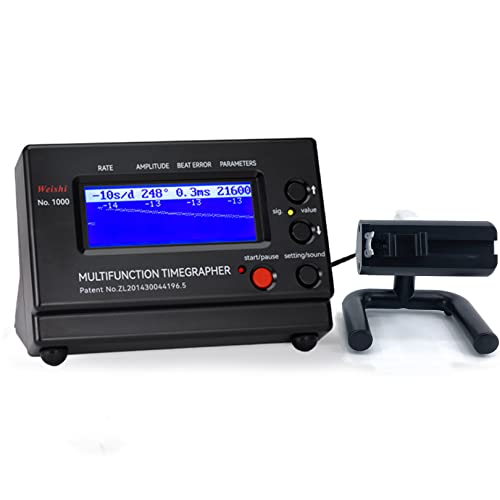
Check Price On AmazonFor shoppers comparing watch timing machines for watchmakers, this No.1000 timegrapher is a straightforward option for checking core mechanical-watch performance. Its LCD screen displays live rate, amplitude, beat error, beat, and lift angle readings, while automatic signal adjustment helps simplify testing different watches.
Best For: Watch collectors, hobbyists, and professionals who want an easy-to-use tester for most mechanical watches, including coaxial models.
Pros:
- Displays rate, amplitude, beat error, beat, and lift angle.
- Simple operation right out of the box.
- Automatically adjusts the optimal signal level for different watches.
- Includes a one-year warranty and customer support.
Cons:
- The supplied details identify it as a corded-electric unit, so it is not presented as portable or battery powered.
- The case is made from plastic, which may be less substantial than metal-bodied alternatives.
This is a sensible entry point for buyers who value uncomplicated operation and the essential timing measurements. It should appeal especially to home workbenches and general mechanical-watch testing rather than buyers seeking advanced portability features.
Complete Workbench Kit – No.1000 Watchmaker Timegrapher
This No.1000 is one of the more complete watch timing machines for watchmakers, combining live digital measurements with a useful set of included accessories. It supports automatic beat detection from 12,000 to 43,200 and also offers manual beat settings for testing a broad selection of mechanical movements.
Best For: Amateur watchmakers, technicians, manufacturers, and anyone building a dedicated calibration desk.
Pros:
- Measures rate, amplitude, beat error, beat, and lift angle on an LCD screen.
- Supports automatic beat settings from 12,000 to 43,200 plus manual settings.
- Package includes the tester, sensor, US adapter, English manual, and cleaning cloth.
- Designed as a calibration tool for a range of mechanical watches.
Cons:
- It uses AC power and is not described as water resistant.
- The supplied details do not specify a battery option for mobile use.
Its broad beat-range support and included sensor make this a practical choice for a watchmaking bench. The accessory package is particularly useful for buyers who want the main testing equipment and basic setup items together.
Precision Analysis Pick – Multifunctional No.1000 Timegrapher
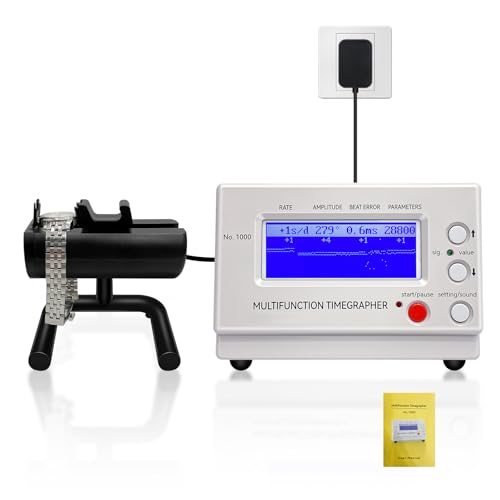
For watchmakers who need more detailed diagnostics, this multifunctional timegrapher expands beyond basic timing checks. It measures daily rate, beat amplitude, polarity, beat, lift angle, and period, with adjustable sampling and directional measurement options that support closer analysis of mechanical movements.
Best For: Watch enthusiasts, makers, manufacturers, and technicians testing or calibrating mid-to-high-end mechanical watches.
Pros:
- Measures daily rate, amplitude, polarity, beat, lift angle, and period.
- Offers a 2–60-second sampling period and one to six directional measurements.
- Provides 0.1 seconds-per-day resolution and 196 high-density sampling points.
- Compact design and 100V–240V ±10% input support flexible workbench use.
Cons:
- It is intended for mechanical watches and is not described as water resistant.
- The more detailed measurement options may be more than casual users need.
- The supplied notes specify a 365-day warranty rather than a longer coverage period.
This model is the strongest fit for users who want diagnostic depth rather than only a basic pass-or-check reading. Its compact build, wide-voltage input, and detailed measurements make it well suited to a technical workbench.
How We Picked the Best Watch Timing Machines for Watchmakers
We focused on the features that matter during real mechanical-watch servicing: readable timing data, useful measurement modes, stable watch positioning, straightforward controls, and compatibility with common mechanical movements. We also considered whether each machine is better suited to occasional hobby work, repair benches, or more demanding professional use.
Because listings can vary by seller and revision, verify the included accessories, power requirements, display language, and stated measurement ranges before ordering. A timegrapher is a diagnostic instrument, so consistency and ease of interpretation matter as much as a long feature list.
Quick Comparison
| Best For | What to Look For | Why It Matters |
|---|---|---|
| Beginners and hobbyists | Simple controls and clear LCD readout | Shortens the learning curve |
| Repair benches | Multiple beat settings and lift-angle adjustment | Supports a wider range of movements |
| Professional servicing | Stable readings, waveform visibility, and reliable construction | Improves repeatability during regulation |
| Portable or occasional use | Compact design and convenient power options | Makes setup and storage easier |
Key Buying Factors for Watch Timing Machines
Measurement and Adjustment Controls
Prioritize machines that display rate, amplitude, beat error, and beat frequency. Adjustable lift angle is particularly useful because the correct setting helps produce more meaningful amplitude readings across different movements.
Display and Waveform Clarity
A bright, readable screen should let you monitor results without interrupting delicate work. Waveform or trace displays can help identify irregular beats, noise, and other patterns that a single rate number may hide.
Movement Compatibility
Confirm that the unit supports the frequencies and beat rates used by the watches you service. Most are intended for mechanical watches, but the practical range of supported movements varies. Check whether manual-wind and automatic watches can be tested in the positions you need.
Build Quality and Positioning
A secure holder and low-vibration base help prevent inconsistent readings. Look for controls that are easy to operate while the watch is mounted, and avoid placing any timegrapher on an unstable or resonant surface.
Power and Included Accessories
Check voltage, plug type, adapters, and any included microphone or mounting components. A model advertised for 110V–220V may still require the correct regional plug adapter, so confirm the exact package before purchase.
Who Should Buy Which Watch Timing Machines for Watchmakers?
For hobbyists and first-time users, a straightforward No.1000-style timegrapher with a clear LCD screen is usually the best value. It provides the core readings needed for basic regulation without adding unnecessary complexity.
For busy repair benches, choose a multifunction model with broader beat-rate support, adjustable settings, and a stable holder. These features are more valuable than cosmetic extras when testing multiple movements.
Professional watchmakers should favor the clearest display, dependable repeatability, and flexible calibration controls available within their budget. Whichever model you choose, use it alongside positional testing and sound servicing practices rather than treating one reading as a complete diagnosis.